Public vs Private Universities in Ghana: Which Is Better?
Choosing a university is a “canon event” for every Ghanaian student. Whether you’ve just cleared your WASSCE or you’re an international student looking to experience the “Year of Return” vibes permanently, the big question remains: Public vs Private Universities in Ghana—which one is actually better?
At Getrooms, we see thousands of students every semester navigating this exact dilemma. Some are looking for the prestige and “vibes” of Legon, while others want the focused, high-tech environment of a private institution. Between calculating the cost of universities in Ghana and worrying about where you’ll sleep, the stress is real.
Don’t “crash out” just yet! We’ve broken down everything you need to know to make the right choice for your future.
Overview of Public Universities in Ghana
Public universities are the traditional heavyweights of the Ghanaian education system. Funded largely by the government, these institutions are known for their massive campuses, deep historical roots, and intense academic competition.
Characteristics and Reputation
Public universities often carry a “big name” advantage. They are known for:
- Large Student Populations: Places like the University of Ghana (Legon) and KNUST host tens of thousands of students.
- Research Power: In the 2026 global rankings, public universities like UG have made bold strides in the research environment and industry engagement.
- Affordability: Generally, the tuition is subsidized for Ghanaian citizens, making them the primary choice for many.
Top Examples
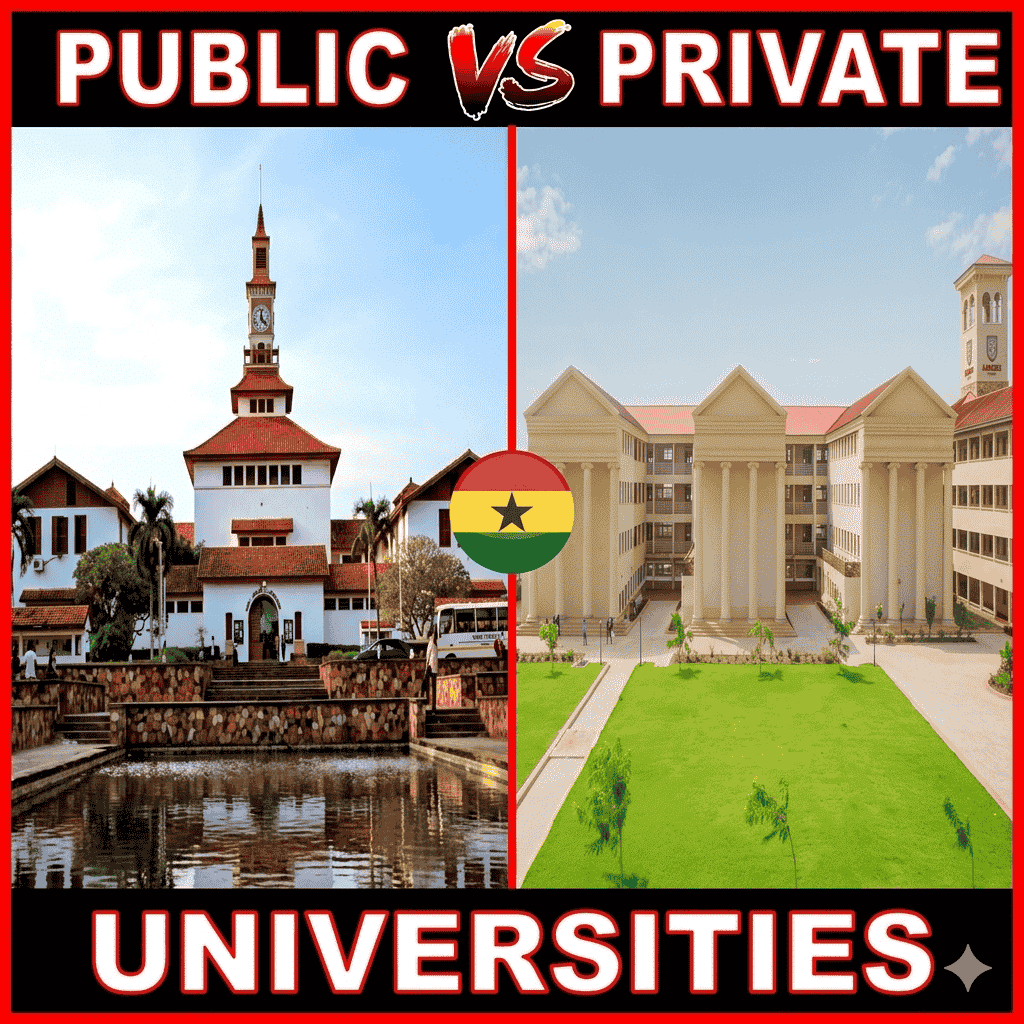
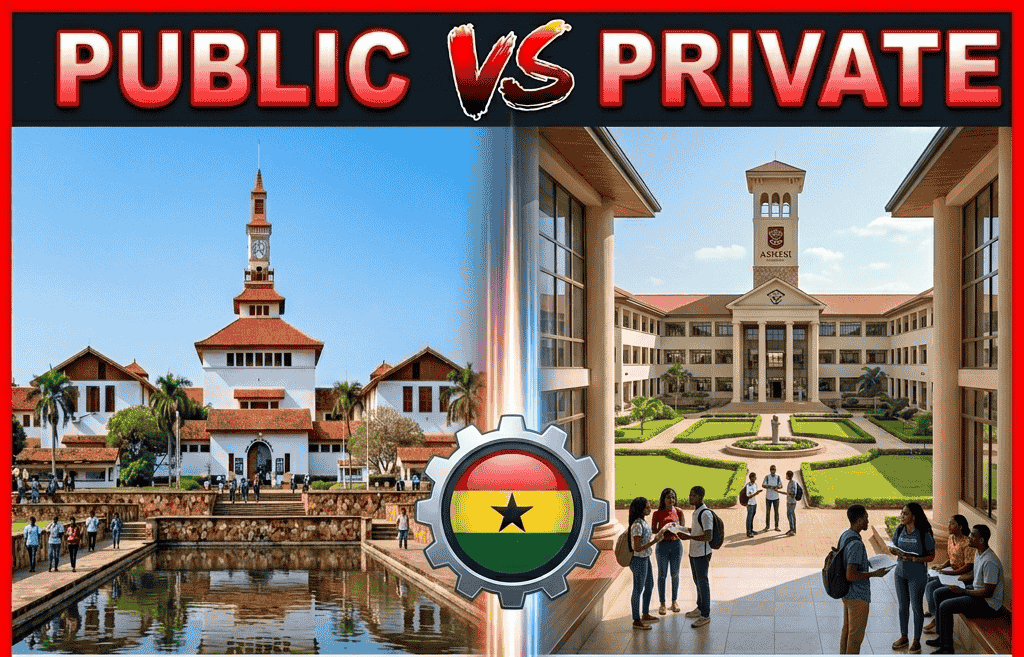
- University of Ghana (UG): The premier university, famous for its red-tiled roofs and diverse programs.
- Kwame Nkrumah University of Science and Technology (KNUST): The hub for engineering, pharmacy, and “tech” enthusiasts.
- University of Professional Studies, Accra (UPSA): The go-to for business and professional courses.
Overview of Private Universities in Ghana
Private universities have transformed the landscape of private vs. public education in Ghana. They offer a more tailored, often faster-paced alternative to the traditional public route.
Characteristics and Facilities
Private institutions often focus on niche markets and modern employability skills. Their hallmarks include:
- Small Class Sizes: You aren’t just a number; lecturers actually know your name.
- Modern Infrastructure: Many private schools invest heavily in the latest labs and high-speed internet.
- Flexibility: They often offer more flexible schedules for working students or those who want to finish their degrees without the occasional disruptions seen in the public sector.
Top Examples
- Ashesi University: Globally recognized for its liberal arts curriculum and high graduate employability.
- Central University: One of the largest private institutions with a wide range of accredited programs.
- Valley View University: Ghana’s first chartered private university, known for its disciplined environment.
Key Comparison: Public vs Private Universities in Ghana
When deciding on public vs. private universities in Ghana, you need to look at the “aura” of each category across several practical pillars.
1. Tuition and Affordability
The cost of universities in Ghana is often the deciding factor.
- Public: Usually cheaper for “Regular” students, though “Fee-paying” and “Evening” streams can be expensive.
- Private: Generally higher tuition. However, schools like Ashesi offer significant scholarship packages for “needy but brilliant” students.
| Feature | Public University | Private University |
| Typical Annual Fees | GHS 3,000 – GHS 8,000 | GHS 10,000 – GHS 60,000+ |
| Funding | Government Subsidized | Private/Tuition-led |
| Hostel Costs | Often cheaper (but competitive) | More expensive (but available) |
2. Admission Requirements
Public universities are notoriously strict with their cut-off points, especially for competitive courses like Medicine or Law. Private universities often provide a “second chance” with more flexible entry requirements, though top-tier ones like Ashesi still maintain very high standards.
3. Quality of Education and Facilities
Public universities have the best-established libraries and historical resources. However, private universities often lead in the benefits of Private Universities in Ghana when it comes to technology and specialized equipment. For instance, if you want a lab where you don’t have to share a microscope with five other people, a private school might be the move.
4. Class Size and Student Experience
If you enjoy the “crowd vibe” and the massive social scene of “Pent” or “JQF,” the public is for you. If you prefer a tight-knit community where you can easily network with your dean, private is better.
Advantages of Public Universities
There’s a reason why thousands of students fight for a spot in public institutions every year. The advantages of public universities are rooted in prestige and scale.
- Networking: You meet people from every corner of the country and beyond. The alumni networks are massive.
- Extracurriculars: From sports to massive campus festivals, the “student life” at a public university is unmatched.
- Subsidized Costs: For many, the low tuition is the only way to get a degree.
- Recognized Pedigree: Many employers in Ghana still hold a slight bias toward degrees from “traditional” schools like Legon or KNUST for certain civil service roles.
Benefits of Private Universities in Ghana
On the flip side, the benefits of Private Universities in Ghana are becoming more apparent in the 2026 job market, where “soft skills” and “tech-savviness” are king.
- Employability: Schools like Ashesi and Lancaster often have direct pipelines to multinational companies in Accra.
- No Strikes: Private universities rarely experience the industrial strikes that can sometimes delay graduation in public schools.
- Personalized Learning: With smaller classes, you get more “one-on-one” time with lecturers, which is great if you struggle with certain subjects.
- Modern Curriculum: They can often update their courses faster to reflect global trends like AI and Digital Marketing.
Which Is Better for You?
The “best” university depends entirely on your personal situation.
- Choose Public if: You are on a budget, want the “full” Ghanaian campus experience, and have the WASSCE grades to beat the high competition.
- Choose Private if: You want a faster, more personal education, have the funds (or qualify for a scholarship), and want to enter the corporate world with a specialized edge.
No matter where you choose, one thing remains constant: you need a place to stay. Finding a hostel shouldn’t be a “side quest” that leaves you exhausted. At Getrooms, we’ve made it easy to find verified hostels near all the major public and private campuses.
Conclusion
In the debate of Public vs Private Universities in Ghana, there is no wrong answer—only the best fit for your goals. Public universities offer prestige and affordability, while private universities provide flexibility and modern facilities.
Education is an investment in your “aura” and your future. Take your time, do your research on our blog, and choose the path that makes you feel “rich in life.”
Ready to start your university journey?
Don’t wait until the last minute to secure your room.
- Check out our pricing plans to get direct access to hostel managers: Getrooms Pricing
- Start searching for your dream hostel across 60+ universities: Find a Hostel
Which side are you on? Public or Private? Let us know in the comments below!